
Manufacturing of five-cent pieces in 1974 followed the standard United States Mint coinage program.
Operations occurred across three primary facilities.
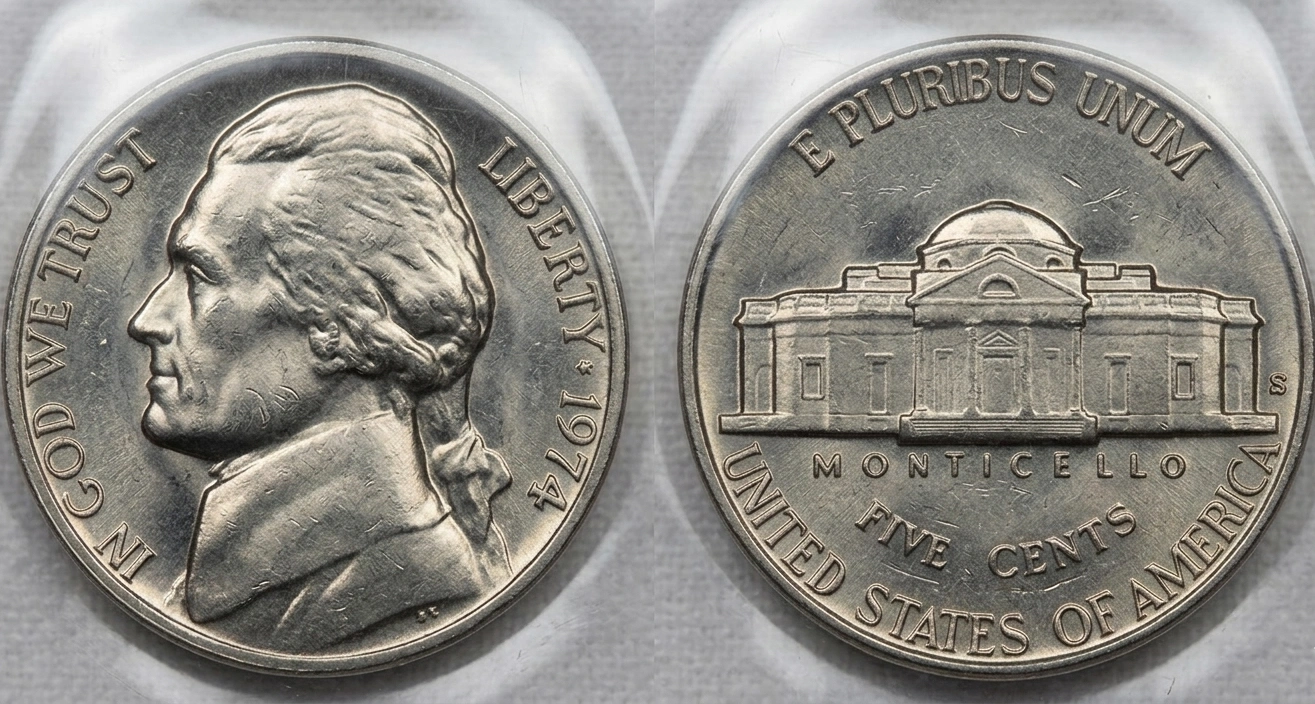
Philadelphia’s mint traditionally omitted a mint mark on its production for this specific year.
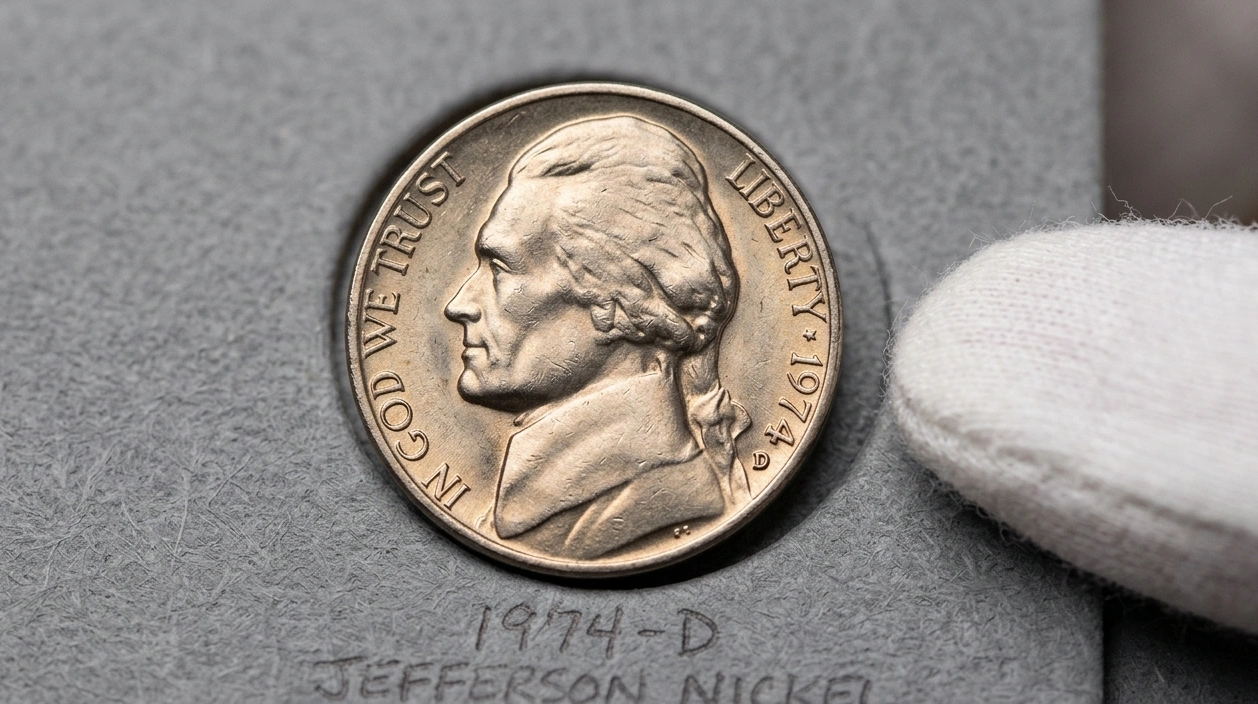
Denver’s facility marked its coins using a “D” letter.
San Francisco focused exclusively on producing high-quality Proof coins bearing the “S” mark.
Determining the 1974 nickel value depends heavily on the sharpness of the stairs on the back (Monticello).
| Characteristic | Value |
| Metal Mix | 75% Copper, 25% Nickel |
| Weight | 5.00g |
| Diameter | 21.20mm |
| Thickness | 1.95mm |
| Edge Type | Plain |
| Designer | Felix Schlag |
Mintage Statistics by Mint Location
Total production volume exceeded 800 million units.
Mintage distribution remains recorded in official Mint reports.
- Philadelphia (No Mint Mark): 352,168,000
- Denver (D): 477,700,000
- San Francisco (S, Proof): 2,612,568
High mintage figures ensure a constant presence in daily circulation.
Finding circulated specimens yields no numismatic interest above face value.
Grading Systems and Full Steps Criteria
Evaluating condition requires using the 70-point Sheldon scale.
Full Steps (FS) describes coins possessing 5 or 6 clearly separated stair lines.
Weak striking in this area lowers the coin’s category.
Having small scratches on the stairs cancels the FS status.
| Grade | Description of Characteristics |
| VG-8 | Heavy wear, Jefferson’s hair detail mostly lost |
| EF-40 | Light wear on high points, letters and dates remain sharp |
| MS-63 | Presence of mint luster, possible small marks in the field |
| MS-65 | Strong mint luster, minimal surface defects |
| MS-67 | Ideal condition, lacking visible flaws to the naked eye |
Market Value Dynamics (Philadelphia)
Coins lacking a mint mark in average condition carry a value of $0.05.
Price growth begins at the MS-64 level.
Statistics indicate annual price fluctuations within 2-3% for mid-range grades.
Market indicators for 1974 (P):
- MS-63: $0.25
- MS-65: $1.50
- MS-66: $15.00
- MS-67: $150.00
Auction records for a no-mint-mark coin in MS-67 FS condition reached $4,025.
Value increases for MS-67 FS specimens can hit 12% annually when supply remains low.
Market Value Dynamics (Denver)
Denver’s mintage exceeds Philadelphia’s by 125 million.
High supply levels limit upward price movement.
- MS-63: $0.20
- MS-65: $1.25
- MS-66: $12.00
- MS-67: $115.00
Specimens possessing the Full Steps designation are valued significantly higher.
Record pricing for a 1974-D in MS-67 FS condition hit $2,115.
Price drops of 5-7% occur when large quantities of unopened bank rolls enter the market.
Characteristics of the Proof Issue (San Francisco)
Proof coins were manufactured specifically for collector sets.
Production involves a double strike using polished dies on polished blanks.
Having a mirror-like field and frosted image (Cameo/Deep Cameo) defines this type.
Values for 1974-S Proof:
- PR-67 DCAM: $8.00
- PR-68 DCAM: $12.00
- PR-69 DCAM: $18.00
- PR-70 DCAM: $850.00
Record sales for a perfect PR-70 Deep Cameo grade reached $1,495.
PR-70 values decline by 4% annually due to the growing population of certified coins.
Technical Defects and Mint Errors
Minting errors for 1974 include off-center strikes and double strikes.
Possessing a defect increases value regardless of general wear.
Registered error types:
- Off-center strike: $15 to $200 depending on the percentage.
- Broadstrike: $10 to $35.
- Clipped planchet: $12 to $50.
- Die Cracks: $5 to $20.
Moving the image by 50% while keeping the date increases the price by 500% compared to standard coins.
Analyzing Wear in Circulation
Serving the active economy, this metal mix lasts approximately 25-30 years.
Coins from 1974 lose up to 0.1g in weight through friction during circulation.
Jefferson’s cheekbone and the outlines of Monticello’s windows disappear first.
Withdrawal rates for 1970s coins from circulation stay at 1.5% annually.
Reducing the available circulating mass fails to raise prices because of the massive original mintage.
Comparative Investment Analysis
Investing in 1974 nickels requires choosing top-grade coins and using the free coin identifier.
Purchasing coins below MS-66 remains economically illogical.
Ten-year yield table:
| Coin Type | Price Change (%) |
| 1974 MS-65 | +5% |
| 1974 MS-66 FS | +45% |
| 1974-D MS-67 FS | +78% |
| 1974-S PR-69 | -12% |
Holding Full Steps status guarantees liquidity within the numismatic market.
Specimens lacking this status sell at a significant discount.
Luster Preservation Factors
Mint luster forms through microscopic lines on the metal surface.
Storing in high humidity causes darkening (toning).
Cleaning a coin with abrasive materials destroys its collector value.
Using chemical solutions on nickels leads to unnatural surface color changes.
Professional certification prevents further oxidation.
Population Reports
Data from leading grading services (PCGS and NGC) determines rarity.
Philadelphia 1974 coins in MS-67 grade number fewer than 50 specimens.
Denver 1974-D coins in MS-67 grade exceed 150 certified units.
Low populations in top grades result from poor blank preparation in 1974.
Blanks often featured numerous surface flaws before being struck by the die.
Auction Procedures
Selling rare specimens occurs through specialized platforms.
Heritage Auctions and Stack’s Bowers record final lot prices.
Auction house commissions typically range from 17.5% to 20% of the hammer price.
Realized prices depend directly on the availability of high-resolution photography.
Auction results from 2023 show stabilized demand for 1970s nickels.
Macroeconomic Indicators
Metal value within the coin stays below its face value.
Global metal prices do not influence the numismatic value of 1974 issues.
Inflation in the US indirectly raises the price of storage accessories.
General digital trends reduce the physical circulation of coins in retail.
Collectors increasingly shift toward remote buying via certificate registries.
Identifying Fakes
Falsifying 1974 coins happens rarely due to low base value.
Attempts to mimic Full Steps status through mechanical engraving exist.
Using a microscope allows to check coin value for the identification of tool marks.
Weight must match 5 grams with a 0.194g tolerance.
Failing to match the weight indicates non-original metal mixtures.
Design Chronology
Felix Schlag’s design has been used since 1938.
Modifying the master hub did not occur in 1974.
Font styles for the date and inscriptions match mid-1970s standards.
Placing the mint mark to the right of Monticello continued until 2004.
Design stability assists automated coin sorting processes.
Role of Mint Rolls in Quality Preservation
Bank rolls serve as the primary source for Uncirculated coins.
One roll contains 40 coins totaling $2 in face value.
Staying inside a roll protects coins from mechanical friction.
End-rollers often develop one-sided toning.
Opening original 1974 rolls today is practiced solely to find FS specimens.